Hydrogen Meets Electric: Hyundai XCIENT Semi
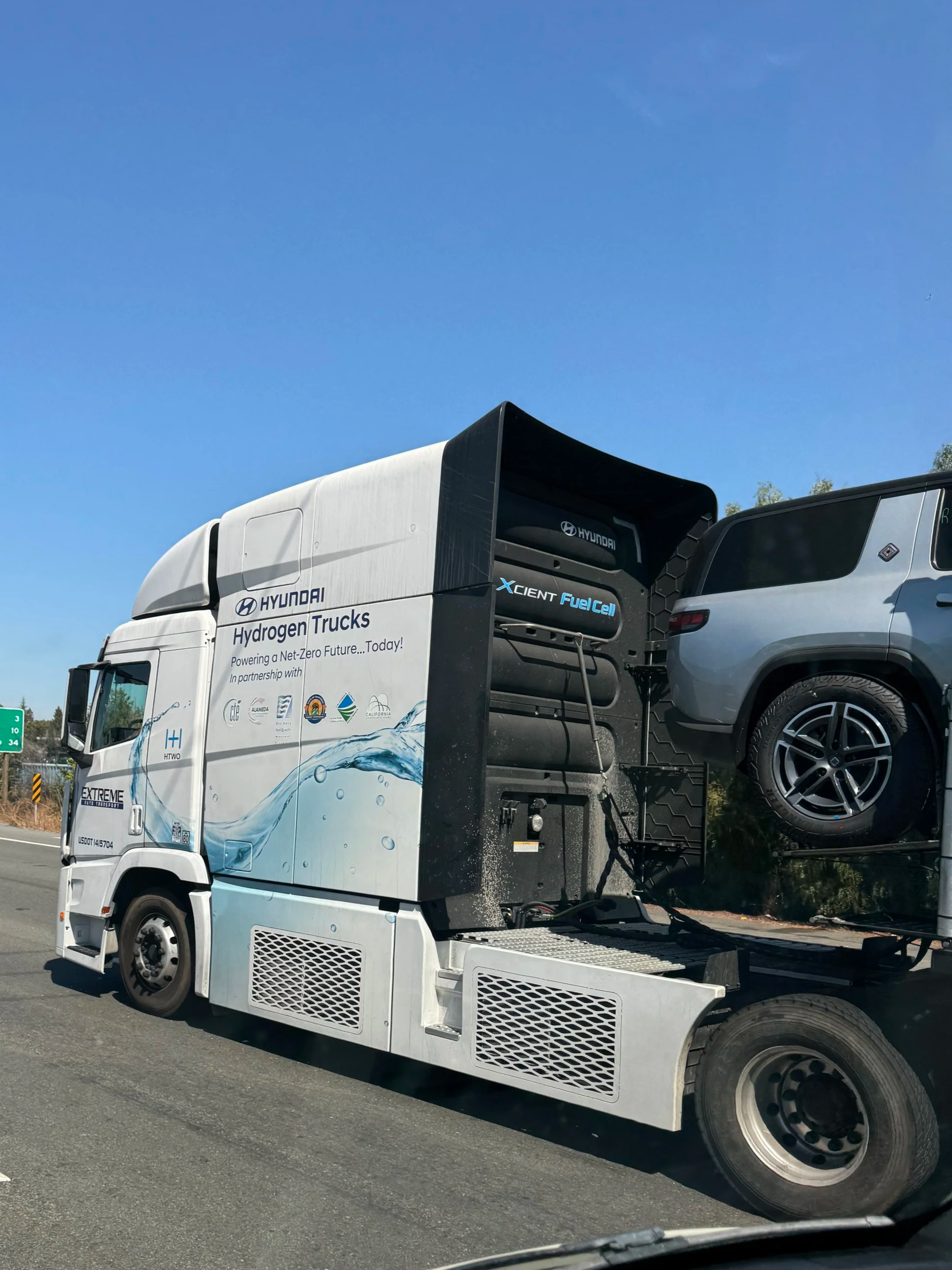
Hydrogen Meets Electric: Spotting a Hyundai XCIENT Fuel Cell Truck Hauling Rivian R1Ts on Highway 101
Silicon Valley has always been ground zero for the future of technology. But every once in a while you see something on the road that perfectly captures where transportation is heading.
That moment happened recently on Highway 101.
Cruising down the freeway, traffic moving at its usual Silicon Valley pace, something unusual came into view ahead: a car hauler loaded with several brand-new Rivian R1Ts. At first glance that’s not too unusual in the Bay Area—Rivian’s headquarters is just down the road in Palo Alto, and seeing their electric trucks around town has become fairly common.
But the real surprise wasn’t what was on the trailer.
It was what was pulling it.
A Rare Sight: Hyundai XCIENT Fuel Cell Truck
The tractor hauling the Rivians wasn’t diesel and it wasn’t battery electric. Instead, it was a Hyundai XCIENT Fuel Cell, one of the world’s first mass-produced hydrogen-powered heavy-duty trucks.
At a glance, the XCIENT looks like a conventional Class-8 semi, but underneath the cab is a completely different drivetrain architecture.
Instead of a diesel engine, the truck runs on a hydrogen fuel cell system paired with electric motors, producing electricity onboard to power the drivetrain. The only byproduct from the system is water vapor.
For heavy-duty freight, hydrogen fuel cells solve one of the biggest challenges facing battery electric trucks: range and refueling time.
Key specs for the XCIENT Fuel Cell truck include:
180 kW hydrogen fuel cell system
350 kW electric motor
72 kWh battery buffer
Up to ~450 miles of driving range
Gross combination weight up to 82,000 lbs
In other words, it’s designed to do the same job as a traditional diesel semi—just without the emissions.
Hydrogen Truck Hauling Electric Trucks
The irony of the scene was almost poetic.
Here was a hydrogen-powered truck hauling fully electric pickup trucks down one of the busiest technology corridors in the world.
The Rivian R1T itself represents one of the newest waves of electric vehicles—high-performance adventure trucks powered entirely by batteries. Meanwhile, the Hyundai XCIENT represents another potential future: hydrogen fuel cell logistics for heavy freight.
Both technologies are chasing the same goal:
Decarbonizing transportation.
Heavy-duty trucking is responsible for a disproportionate share of transportation emissions. Hydrogen fuel cell trucks like the XCIENT aim to tackle long-haul freight where battery weight, charging time, and infrastructure can be limiting factors.
Not Just a Prototype
What makes the sighting even more interesting is that the XCIENT isn’t just an experimental concept truck.
Hyundai began deploying these trucks commercially in 2020, making them the first production hydrogen fuel cell heavy-duty trucks in the world.
They’ve already been operating in Europe and in pilot programs in North America, logging millions of kilometers of real-world driving.
In California specifically, hydrogen freight trucks are being tested in logistics operations around major ports and distribution centers.
Which makes Silicon Valley a logical place to see one in the wild.
The Future Rolling Down 101
Watching that rig roll past—silent compared to diesel semis—was a glimpse of the transportation transition happening right now.
A hydrogen truck hauling electric trucks.
Both technologies born from decades of engineering evolution.
Both sharing the same road.
And both hinting that the next generation of transportation might look very different from the diesel-dominated highways we grew up with.
But on Highway 101 that day, it wasn’t a concept or a press release.
It was real.
And it was moving freight.